
Short Answer
The premise: SaaS Pegasus is still the most mature Django SaaS boilerplate in 2026 — the article gives it genuine credit up front. But three cracks send people looking for alternatives: Stripe lock-in, the fork-and-merge upgrade model, and per-project pricing that punishes serial shippers. And the rise of AI coding tools (84% of devs now use or plan to use them, per Stack Overflow 2025) has changed what builders need from a foundation.
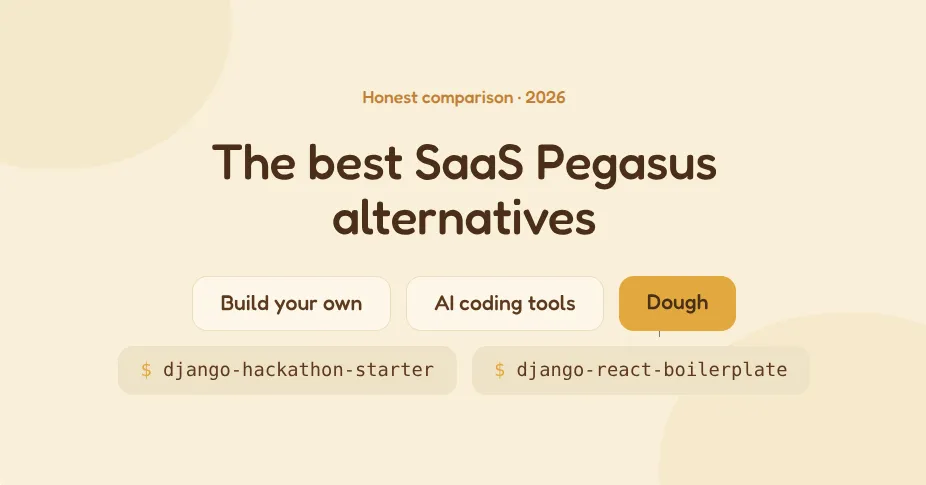
The five alternatives, ranked by verdict:
- Build your own — looks free, actually costs days to weeks, and makes you the unpaid maintainer of your own fork. For almost nobody.
- Vibe-code from scratch (Claude Code / Cursor) — magical for prototypes, dangerous for production: 66% of devs cite "almost right but not quite" AI code, and auth/billing is exactly where "almost right" becomes a breach or lost revenue.
- Dough — the strongest new contender for people who ship multiple products: anti-lock-in (100+ payment providers, 50+ social logins, 15+ ESPs), sell anything (subscriptions, lifetime, complex pricing), and a one-command dough update that kills the "fork tax." Honest downside: it's new, small community.
- django-hackathon-starter — free, useful for learning OAuth patterns, but vintage (Bower, Google+ era). Hackathons only.
- Vinta's django-react-boilerplate — the best free, actively maintained modern foundation, but it's a project boilerplate: no billing, teams, or SaaS layer.
The core thesis: boilerplates and AI aren't competitors — the winning 2026 workflow is a proven boilerplate for the dangerous, boring 80% and AI code for the unique 20%. If you ship one product, buy Pegasus. If you ship many, Dough's update-forever, lock-into-nothing model is built for you.
Here's a number that should reframe how you think about SaaS boilerplates: according to the 2025 Stack Overflow Developer Survey, 84% of developers now use or plan to use AI tools in their workflow — up from 76% just a year earlier. The way we build software has fundamentally changed. And yet, most SaaS boilerplates are still sold the same way they were in 2020: buy a codebase, fork it, and good luck navigating the SaaS ecosystem in 2026.
If you're reading this, you've probably lived some version of the following story. You had an idea. A good one, even. You opened your editor, full of energy, ready to build The Thing. And then you spent the next two weeks building... not The Thing. You built login forms. Password reset emails. Stripe webhooks. A "Forgot password?" flow that you have personally implemented so many times you could do it in your sleep, and yet somehow it still took a day and a half.
By the time you got to The Thing — the actual product, the reason you started — your enthusiasm had the structural integrity of a wet paper towel.
SaaS Pegasus exists to solve exactly this problem, and it solves it well. It's arguably the most mature Django SaaS boilerplate on the market. But "most mature" doesn't automatically mean "right for you" — especially in 2026, when you might be shipping three products a year with an AI copilot instead of laboring over one, and when getting locked into a single payment provider feels a lot riskier than it used to.
So in this article, we're going to do an honest comparison of the best SaaS Pegasus alternatives — and, more broadly, the best saas boilerplates in 2026 for cutting development time when you're building a SaaS product. We'll cover building your own boilerplate (and why that's usually a trap), vibe-coding everything from scratch with Claude Code or Cursor (and why that's a different trap), a new anti-lock-in contender called Dough, and the best free open-source options. By the end, you'll know exactly which path fits your situation — even if that path is "just buy Pegasus."
First, Credit Where It's Due: What SaaS Pegasus Actually Is
Before we talk alternatives, let's be fair to the incumbent. Trash-talking the market leader to sell you something else is the oldest trick in the affiliate-blog playbook, and it's beneath both of us.
SaaS Pegasus is a Python/Django SaaS boilerplate — a starter kit that ships the full SaaS stack out of the box — built by Cory Zue, a former CTO with a long track record of shipping Django products. It's been around since 2020, which in boilerplate years makes it a wise village elder. It gives you user accounts, teams and invitations for multi-tenant apps, Stripe subscriptions, an e-commerce module, AI integration examples, two-factor auth, background tasks with Celery, a choice of React or HTMX on the front end, and a choice of CSS frameworks (Tailwind, Bootstrap, or Bulma).
Pricing is a flat one-time payment: roughly $249 for Starter (basic features, one project), $449 for Professional (full features, one project), and $999 for Unlimited (everything, unlimited projects). Reviews are genuinely glowing — one buyer famously described it as "CTO in a box", and the documentation and founder support get consistent praise.
If you're building one serious Django SaaS and you want the most battle-tested foundation money can buy today, Pegasus is a strong default. Full stop.
So why is this article 3,000 words long instead of one paragraph?
The Cracks That Make People Look for Alternatives
Three reasons come up again and again when developers go hunting for a Pegasus alternative:
1. The payment lock-in. Pegasus is built around Stripe. That's fine — until it isn't. Stripe is famous for suddenly freezing or closing accounts in "high-risk" categories, and if your entire billing stack is welded to one provider, a deplatforming event isn't an inconvenience, it's an extinction event. Re-integrating a new payment provider into a codebase designed around Stripe is weeks of work, done under panic conditions.
2. The upgrade model. Pegasus works via a codebase generator: you configure your project, download the code, and build on top of it. When a new Pegasus version ships, you re-generate and merge the changes into your customized code. It's a well-documented process, but it is a merge — and the more you've customized, the hairier it gets. Multiply that by every project you've shipped, and maintenance starts compounding like a bad loan.
3. The per-project math. If you're a serial shipper — the "I launch a micro-SaaS every quarter" type — the single-project licenses don't fit your life, and even the $999 unlimited tier means you now own several diverging forks, each of which needs updating separately.
None of these are dealbreakers for everyone. But if any of them made you wince in recognition, keep reading.
Comparison Table: SaaS Pegasus Alternatives at a Glance
Here's the 30-second version before we go deep:
Alternative Cost Best for Biggest weakness Build your own boilerplate "Free" (weeks of your life) Control freaks, learners Enormous hidden time cost Vibe-code from scratch (Claude Code / Cursor) AI subscription Prototypes, weekend experiments Security-critical code, consistency across products Dough (dough.sh) ~$299 Serial shippers who fear lock-in New product, small community django-hackathon-starter Free (MIT) Hackathons, learning OAuth patterns Ancient, not production-ready vintasoftware/django-react-boilerplate Free (MIT) Django+React teams No billing, teams, or SaaS features The Django Packages long tail Mostly free Spelunkers Quality varies wildly
Now let's take each one apart properly.
Alternative #1: Build Your Own Boilerplate (The Siren Song of DIY)
Every developer has this thought at least once: "Why would I pay $449 for code I could write myself?"
It's a fair question, and the honest answer is: you absolutely could write it yourself. The problem isn't ability. The problem is that "a SaaS boilerplate" is one of those projects that looks like a weekend and behaves like a fiscal quarter.
Think of it like deciding to bake your own bread. Not sourdough-hobby bread — all your bread, forever, from wheat you also grow. The first loaf is romantic. By loaf forty, you're standing in your kitchen at 11pm wondering why you're milling flour instead of living your life.
Here's what "just the basics" actually contains once you write it all down:
- Authentication: sign-up, login, email verification, password reset, social login, session security
- Billing: checkout, webhooks, proration, failed payments, dunning emails, invoices, tax handling
- Teams: invitations, roles, permissions, the seventeen edge cases of "what happens when the last admin leaves"
- Email: transactional templates, an ESP integration, deliverability configuration
- The unglamorous rest: settings management, Docker setup, CI, error monitoring, GDPR consent, admin tooling
In practice, building a clean version of this — not a duct-taped one, but something you'd genuinely want under three or four future products — takes days to weeks of full-time work. And that's the optimistic scenario where you don't fall down a "which auth library is best in 2026" research hole (you will).
But here's the part nobody tells you, and it's the real kicker: the day you finish your boilerplate, you become its maintainer. Django ships a new version. A dependency gets a CVE. Stripe changes an API. Your beautiful hand-rolled foundation is now a second job that pays zero dollars. You didn't escape the fork problem — you just built the fork yourself, with extra steps.
Build your own if: you're doing it explicitly to learn, or your requirements are so unusual that no off-the-shelf option fits (rare — be honest with yourself).
Skip it if: your goal is shipping products. The math almost never works.
Alternative #2: Vibe-Code Everything with AI Coding Tools (Claude Code & Cursor)
This is the genuinely new option — the one that didn't exist when Pegasus launched in 2020. Why buy a boilerplate at all when Claude Code or Cursor can generate a login system while you make coffee?
It's a serious question, and anyone who tells you AI tools haven't changed the calculus is selling something. With a good agentic coding tool, you can stand up a working Django app with auth, a Stripe checkout, and a landing page in an afternoon. For prototypes and weekend experiments, this is legitimately magical, and if that's your use case, you can stop reading and go build.
But there's a reason the honest answer for production SaaS is more complicated, and the data backs it up. In that same Stack Overflow 2025 survey, the single biggest frustration — cited by 66% of developers — was AI output that's almost right but not quite, and 45% said debugging AI-generated code is more time-consuming than expected. More developers actively distrust AI output accuracy (46%) than trust it (33%).
"Almost right" is a fine failure mode for a dashboard widget. It is a catastrophic failure mode for the three areas boilerplates exist to cover:
- Auth. A subtly broken session or password-reset flow isn't a bug, it's a breach.
- Payments. A webhook handler that's 95% correct means 5% of your revenue events silently vanish.
- Email deliverability. You won't know it's misconfigured until your reset emails have been landing in spam for a month.
There's also a subtler problem for serial shippers: consistency. Vibe-code five products from scratch and you get five different auth systems, five different billing integrations, five slightly different security postures — each one a unique snowflake you alone understand. A security patch is now five separate archaeology expeditions.
The plot twist? AI tools and boilerplates aren't competitors — they're a combo. The workflow that's winning in 2026 is pointing Claude Code or Cursor at a proven foundation: the boring, dangerous 80% is battle-tested code, and the AI code fills in the unique 20% on top. The boilerplate becomes the guardrails that keep "almost right" from ending up in your checkout flow.
Vibe-code from scratch if: you're prototyping, learning, or building internal tools where a payments bug means a Slack message, not a refund storm.
Skip it if: real money and real user data are involved. Use the AI on top of a foundation instead.
Alternative #3: Dough (dough.sh) — The Anti-Lock-In Boilerplate
Dough is the newest entrant on this list, and it's built around a thesis that will resonate hard with anyone who winced at the "cracks" section above: the biggest long-term cost of a boilerplate isn't the price tag — it's the lock-in.
Like Pegasus, Dough is Django-based (Django, Celery, Redis under the hood). Unlike Pegasus, it's aggressively agnostic about everything else, and the numbers on its comparison page are striking:
- 100+ payment processors through a payment orchestration layer — Stripe, Adyen, Braintree, Worldpay, Checkout.com and more, across 150+ payment methods. Crucially, you can switch providers via configuration instead of rewriting your checkout code. If Stripe deplatforms you on a Tuesday, you're on a new provider by Wednesday.
- 50+ social login providers, plus any OpenID Connect provider and SAML 2.0 SSO — the auth feature enterprise B2B SaaS buyers demand — with magic-link login built in.
- 15+ email senders (ESP or SMTP), so a deliverability problem or a price hike is a config change, not a migration.
- Frontend choice: Svelte, Vue, React, or plain HTML — versus Pegasus's HTMX/React pairing.
- Sell anything: subscriptions, lifetime licenses, one-off purchases, options, and complex tiered pricing — where Pegasus focuses on subscriptions plus one-off payments.
The Fork Tax (and How Dough Skips It)
Dough's most interesting idea is its upgrade model. Traditional boilerplates hand you code that you fork and customize — which means the day you clone it, your copy starts drifting from upstream, and every future improvement is a manual merge. Dough calls this the fork tax, and it's a genuinely useful name for a cost every boilerplate buyer eventually pays.
Dough's answer is a dough update command: the core (payments, auth, email) lives in a layer you don't edit, so pulling the latest version is one command with zero merge conflicts — across every product you've built on it. If you ship one product a year, this is a nice-to-have. If you ship four, it's the difference between "maintenance weekend" and "maintenance minute."
This is also why Dough explicitly targets — their words — vibe-coders who ship more than one thing. One stable, well-understood base that Claude Code or Cursor can reshape per product, with updates that propagate everywhere at once, is arguably the ideal substrate for AI-assisted serial shipping.
The Honest Downsides
Dough's own compare page keeps the rows it loses in — and credit to them, because the weaknesses are real:
- It's new. Small community, short track record. Pegasus has five-plus years of production hardening; Dough doesn't, yet.
- Their own guidance: if you want the single fastest solo B2C launch with a huge template community, ShipFast (Next.js) is hard to beat; if you need a years-mature codebase today, Pegasus has the head start; and if you're all-in on JavaScript/Vercel and don't want a Python backend, look elsewhere entirely.
At roughly $299, it sits right in Pegasus territory on price. The bet you're making isn't about money — it's maturity versus optionality.
Pick Dough if: you ship multiple products, you fear provider lock-in (payments especially), you sell more than a simple monthly plan, or you're an agency shipping client projects on one updatable base.
Skip it if: you need maximum battle-testing today, or you only ever sell one simple subscription and the optionality is wasted on you.
Alternative #4: Django Hackathon Starter (Free, Open Source, and… Vintage)
Now for the free options — because "just use open source" is the reply-guy answer to every "which boilerplate?" question, and it deserves a fair hearing.
django-hackathon-starter is an MIT-licensed Django boilerplate with about 1.6k GitHub stars. Its pitch is right there in the name: at a hackathon, you don't want to burn your first six hours wiring up OAuth, so this repo ships with pre-built OAuth 1.0a and 2.0 flows (GitHub, Twitter, LinkedIn, Facebook, Dropbox, Foursquare and more) plus a stack of working API integration examples — Yelp, Twilio, Steam, the New York Times, and friends — alongside Django REST Framework integration and basic user registration.
For its intended purpose — hackathons and learning how OAuth flows are actually structured in Django — it's a genuinely useful reference.
But we promised honesty, so: this is not a 2026 production SaaS foundation. The tell is in the setup instructions, which still rely on Bower for front-end dependencies — a package manager that was deprecated years ago — and the integrations include the Google+ API, a product that no longer exists. There's no billing, no teams, no subscription logic, and the dependency tree is a museum exhibit.
Pick it if: you're at a hackathon, or you want to read clean examples of OAuth wiring in Django.
Skip it if: actual customers will ever touch the thing.
Alternative #5: Vinta's django-react-boilerplate (The Best Free Option in 2026)
django-react-boilerplate by Vinta Software is the strongest free option on this list, and the contrast with the hackathon starter is night and day. It's MIT-licensed, has around 2.3k stars, and — this is the important part — it's actively maintained: as of mid-2026 it ships Django 5, React with TypeScript, Tailwind 4, Celery for background tasks, Django REST Framework with auto-generated OpenAPI schemas and TypeScript client code, Sentry error monitoring, sensible security defaults (django-csp, django-defender, brute-force protection), pre-commit quality tooling, and a one-click Render.com deployment config.
This is what a professional agency's internal starting point looks like when they open-source it — because that's literally what it is. Vinta uses it for client products, and it shows in the details, like the opinionated ATOMIC_REQUESTS and Celery reliability settings that come from real production scar tissue.
So what's the catch? Simple: it's a project boilerplate, not a SaaS boilerplate. There's no billing. No subscription management. No teams or invitations. No multi-tenancy. No transactional email templates for your lifecycle flows. It hands you an excellent, modern Django+React chassis — and then you build the entire SaaS layer yourself, which loops you right back to Alternative #1's "days to weeks" problem, just with a nicer starting line.
Pick it if: you want a modern Django+React foundation, you're comfortable building billing and teams yourself (or your product doesn't need them), and free matters.
Skip it if: "auth, billing, teams, email — done" is the whole reason you're shopping.
Honorable Mentions: Next.js, Rails, and the Django Packages Rabbit Hole
Before the rabbit hole, two quick nods outside the Python world. If you'd rather not run a Django backend at all, the most popular Next.js SaaS boilerplate by community size is ShipFast — Dough's own compare page concedes it's hard to beat for a fast solo B2C launch on the JavaScript stack. And on the Rails SaaS side, Bullet Train is the long-standing, well-regarded equivalent, with an open-source core. This article stays Django-focused because that's Pegasus's home turf, but if your stack is genuinely open, those are the names to evaluate.
If you want to see the full landscape, Django Packages' boilerplate listing is the definitive index — and it's quietly revealing. Search "boiler" across nearly 5,000 Django packages and the Starter Project category contains roughly ten entries, with the two repos we just covered sitting at the top by stars.
That tiny number tells you something important: maintaining a genuinely production-grade Django boilerplate is hard, mostly thankless work, which is exactly why the mature ones (Pegasus) charge money and the free ones tend to either go stale (hackathon starter) or stay deliberately narrow (Vinta). The classic exception worth knowing is Cookiecutter Django — a hugely popular community project template — but like Vinta's, it's a project foundation, not a SaaS-features-included foundation.
How to Evaluate SaaS Boilerplates in 2026: A Decision Framework
Strip away the feature tables and the choice comes down to three questions about your actual use case.
Question 1: Is this a prototype or a product? Prototype → vibe-code it from scratch with Claude Code or Cursor and enjoy your afternoon. Product → keep reading.
Question 2: How many things will you ship on this foundation? One product, and you want maximum maturity → SaaS Pegasus remains the safe, boring, correct choice. Multiple products over the coming years → you'll outgrow the fork-and-merge approach fast, the per-project pricing model stops making sense, and Dough's update-forever, lock-into-nothing design is built precisely for you.
Question 3: How allergic are you to spending money? If the answer is "extremely," go with Vinta's django-react-boilerplate and accept that you'll hand-build (or AI-build, carefully) the billing and teams layer. Just do that math honestly: if your time is worth anything, "free plus two weeks" usually costs more than $299.
And whichever base you choose, the 2026 meta-strategy is the same: boilerplate for the dangerous, boring 80%; AI tools for the unique 20%. That combination is faster than either half alone, and it keeps the "almost right, but not quite" failure mode away from your checkout flow.
FAQs
It depends on your stack and how many products you ship. For a single Django SaaS application, SaaS Pegasus is the most mature option. For serial shippers who want to avoid payment and vendor lock-in, Dough is the strongest new contender. On the JavaScript side, ShipFast is the most popular Next.js SaaS boilerplate, and Bullet Train leads for Rails.
For most single-product builders, yes. The $249–$999 pricing model pays for itself if it saves even a few days of development time — and it typically saves weeks. The main reasons to look elsewhere are Stripe lock-in, the fork-and-merge upgrade workflow, and per-project licensing if you ship often.
For prototypes, absolutely — Claude Code or Cursor can scaffold a working app in an afternoon. For production, be careful: 66% of developers report AI code that's almost right but not quite, and auth, billing, and OAuth flows are exactly where "almost right" becomes a security incident. The best 2026 workflow combines both: a proven boilerplate for the backend foundation, AI coding tools (or an AI agent) for your product's unique features, UI, and dashboard.
Vinta's django-react-boilerplate is the best free, actively maintained foundation — modern Django 5, React, Tailwind 4, Celery, and solid security defaults. Just know it's a project starter kit, not a complete SaaS one: you'll build billing, teams, and permission management yourself.
Pegasus covers the B2B basics well (teams, invitations, roles and permissions). If enterprise deals are on your roadmap, check for SAML SSO support specifically — it's the feature enterprise buyers ask for first, and it's built into Dough while requiring extra work on most alternatives.
The Bottom Line
SaaS Pegasus earned its reputation, and nothing here changes that: for a single, serious Django SaaS, it's still the benchmark. But 2026 isn't 2020. The defining trend in SaaS and AI right now is that agentic coding tools have made shipping multiple products realistic for solo developers, and that shift exposes the old boilerplate model's weak spots — forks that drift, payment providers you can't leave, licenses priced per project.
If that's the game you're playing, the honest ranking looks like this: Dough for serial shippers who want one evergreen, provider-agnostic base; Vinta's django-react-boilerplate for the best free modern foundation (bring your own billing); Claude Code or Cursor from scratch for prototypes only; django-hackathon-starter for hackathons and OAuth homework; and rolling your own for almost nobody.
Whatever you pick — pick, and go build The Thing. It's been waiting long enough.
Sources
2025 Developer Survey — AI section.
Stack Overflow. (2025). _2025 Developer Survey — AI section._ https://survey.stackoverflow.co/2025/ai
Stack Overflow's 2025 Developer Survey Reveals Trust in AI at an All Time Low
Stack Overflow. (2025, July 29). _Stack Overflow's 2025 Developer Survey Reveals Trust in AI at an All Time Low_ (press release). https://stackoverflow.co/company/press/archive/stack-overflow-2025-developer-survey/
Pricing
SaaS Pegasus. _Pricing._ https://www.saaspegasus.com/pricing/
SaaS Boilerplates and Starter Kits — A Complete Guide.
SaaS Pegasus / Cory Zue. _SaaS Boilerplates and Starter Kits — A Complete Guide._ https://www.saaspegasus.com/guides/saas-boilerplates-and-starter-kits/
Dough vs the field — honest side-by-side comparison.
Dough. (2026). _Dough vs the field — honest side-by-side comparison._ https://dough.sh/prelaunch/compare/
django-hackathon-starter
Leonard, D. _django-hackathon-starter_ (GitHub repository). https://github.com/DrkSephy/django-hackathon-starter
django-react-boilerplate
Vinta Software. _django-react-boilerplate_ (GitHub repository). https://github.com/vintasoftware/django-react-boilerplate
Boilerplate package listing.
Django Packages. _Boilerplate package listing._ https://djangopackages.org/packages/?q=boiler&category=all&sort=-repo\_watchers
SaaS Pegasus review
SaaSBoilerplates.dev. (2025). _SaaS Pegasus review._ https://saasboilerplates.dev/tools/saaspegasus/
References & Sources
-
2025 Developer Survey — AI section.
• Stack Overflow •
https://survey.stackoverflow.co/2025/ai -
Stack Overflow's 2025 Developer Survey Reveals Trust in AI at an All Time Low
• Stack Overflow •
https://stackoverflow.co/company/press/archive/stack-overflow-2025-developer-survey/ -
Pricing
• SaaS Pegasus •
https://www.saaspegasus.com/pricing/ -
SaaS Boilerplates and Starter Kits — A Complete Guide.
• SaaS Pegasus •
https://www.saaspegasus.com/guides/saas-boilerplates-and-starter-kits/ -
Dough vs the field — honest side-by-side comparison.
• Dough •
https://dough.sh/prelaunch/compare/ -
django-hackathon-starter
• GitHub •
https://github.com/DrkSephy/django-hackathon-starter -
django-react-boilerplate
• GitHub •
https://github.com/vintasoftware/django-react-boilerplate -
Boilerplate package listing.
• Django Packages •
https://djangopackages.org/packages/?q=boiler&category=all&sort=-repo_watchers -
SaaS Pegasus review
• SaaSBoilerplates.dev •
https://saasboilerplates.dev/tools/saaspegasus/