
Short Answer
Picture your entire business balanced on top of one payment processor's mood. That's the setup for most stores, and it's why one automated "account terminated" email can zero out revenue between two sips of coffee — which is exactly what happened to me. This piece walks through the fix: get a real high-risk merchant account instead of gambling on Stripe or PayPal, keep your chargeback ratio boring so underwriters stay calm, and — the part most guides skip — build your checkout so no single provider is welded into your code. Do that last part right and a ban stops being an extinction event and becomes a mildly annoying config change.
Here's a number that should make every online store owner sit up: in April 2026, Visa cut its "excessive merchant" dispute threshold from 2.2% to 1.5% of transactions in North America, the EU, and Asia-Pacific. That's not a typo. If 15 customers out of 1,000 dispute a charge — for any reason, including "I forgot I bought this" — you're now officially a problem merchant in the eyes of the world's largest card network. And your payment processor, who answers to Visa before it answers to you, gets very nervous about problem merchants.
I know exactly how that nervousness ends, because it happened to me. One morning I opened my inbox to a single automated email: my payment account was closed, effective immediately, funds on hold. No warning, no human to call, no appeal that led anywhere except back to the same form letter. Checkout was dead. Revenue went from "normal Tuesday" to zero between two sips of coffee — and it stayed there while I rebuilt everything. That morning is the reason Dough exists.
If you sell supplements, coaching, CBD, courses, subscriptions, or anything else the payment industry files under "high risk," this guide is for you. We'll cover what a high-risk merchant account actually is, why mainstream processors keep dropping high-risk merchants, exactly how to open a high-risk merchant account, and — the part almost nobody writes about — how to architect your store so that no single payment provider can ever take you offline again.
The short answer: get the right account, then make it replaceable
If you only read two paragraphs, read these.
First: if your business model is considered high risk, stop running your store on an aggregator like Stripe, PayPal, or Square and get a dedicated merchant account from a merchant account provider that specializes in high-risk businesses. Aggregators approve you in minutes precisely because they haven't really underwritten you — the real risk review happens after you're processing, which is why the ban always arrives after you've built your business on them. A high-risk merchant account provider underwrites you upfront, knows your industry, and has dramatically less incentive to drop you at the first chargeback spike.
Second — and this is the step everyone skips: treat even that dedicated account as replaceable. One payment processor, however specialized, is still a single point of failure. The stores that genuinely can't be deplatformed keep multiple merchant accounts warm and route transactions through an abstraction layer, so swapping providers is a configuration change instead of a three-week engineering emergency. More on how to build that below.
Now let's unpack all of it.
What is a high-risk merchant account?
A high-risk merchant account is a payment processing account issued to a business that acquiring banks consider more likely than average to generate chargebacks, fraud, refunds, or regulatory headaches. Functionally it does the same job as a standard merchant account — it lets you accept payments by card — but the terms reflect your risk profile: higher rates, deeper underwriting, and usually a rolling reserve.
Think of it like insurance for a 19-year-old driving a sports car. The insurer isn't saying the kid is a bad person. They're saying the category has a track record, and the price reflects the category. Same deal here: being classified as high risk is a statistical judgment about your business type, not a moral one.
Here's what typically distinguishes a high-risk account from a standard one:
- Processing rates: roughly 2.5%–5% per transaction, versus 1.5%–3% for standard accounts
- Rolling reserve: typically 5%–15% of volume held for 90–180 days as a buffer against future disputes
- Underwriting: manual review taking days to weeks, versus instant approval
- Monitoring: ongoing reviews of your chargeback ratios and website, not just a one-time check
- Stability: the trade-off for all of the above — a provider that expected your risk and priced it in, instead of one that panics and pulls the plug
That last line is the entire point. The fees aren't a penalty; they're the cost of a merchant service relationship that doesn't evaporate the first time something goes sideways.
Common high-risk industries: are you considered a high-risk merchant?
You don't get to decide whether you're a high-risk business — the banks decide, mostly via your Merchant Category Code (MCC) and your numbers. Many businesses operate in industries that are designated as high-risk without their owners ever realizing it until an application gets declined. The common high-risk categories include:
- Supplements and nutraceuticals — high refund rates and regulatory scrutiny over health claims make underwriters cautious
- Coaching, courses, and info products — intangible goods with "results may vary" outcomes invite disputes
- CBD and hemp — legal, but most mainstream processors refuse the category outright due to regulatory ambiguity
- Subscription and recurring billing — the forgotten-renewal chargeback is a whole genre
- Travel and event ticketing — long gaps between payment and delivery
- High-ticket or high volume e-commerce — bigger transactions mean bigger disputes
- Brand-new businesses — no processing history is itself an elevated risk signal
Notice something? Almost none of these involve doing anything wrong. You can be deemed high risk simply because your customers buy things they later feel ambivalent about, or because you sell online (card-not-present transactions carry more fraud risk by definition), or because you're new.
What makes a business model high risk
Strip away the industry labels and underwriters are really looking at four things:
- High chargeback rates (or the potential for them). Anything above ~1% of transactions puts you in the danger zone with card networks, and acquirers often enforce stricter limits internally.
- Delayed or intangible fulfillment. The longer the gap between "card charged" and "customer satisfied," the more room for risk of chargebacks.
- Regulatory exposure. Products where the rules are shifting (CBD) or where marketing claims get policed (supplements) create liability the processor inherits.
- Financial unpredictability. High transaction volumes that spike suddenly, high average tickets, or thin operating history all raise flags.
If two or more of those describe you, you're a high-risk merchant whether or not anyone has said the words to you yet — and it's better to hear it from a blog post than from an account termination email.
Why Stripe and PayPal drop high-risk merchants (it's math, not malice)
This is the part that felt personal when it happened to me, and turns out to be the least personal thing in the world.
Stripe, PayPal, and Square are payment service providers — aggregators. You don't get your own merchant account with them; you get a sub-account under theirs. This is why onboarding takes five minutes: they're not really underwriting you, they're letting you borrow their relationship with the acquiring bank. It's genuinely brilliant for a weekend side project.
But it means their risk is pooled. When Visa monitors dispute levels under its Acquirer Monitoring Program (VAMP), it looks at the acquirer's entire portfolio — and the acquirer thresholds are far stricter than the merchant ones. An acquirer's portfolio gets flagged at a fraction of one percent in disputes. So every aggregator runs algorithms hunting for any merchant who might drag the portfolio average up, and the cheapest fix for a flagged merchant is deletion. You're not a customer at that moment; you're a rounding error threatening a much bigger relationship.
The consequences stack up fast:
- Frozen funds. Both Stripe and PayPal reserve the right to hold your balance for up to 180 days after account termination — six months of your revenue in limbo while your bills stay on schedule.
- The MATCH list. If your account is terminated for cause, your acquirer may add you to Mastercard's MATCH list (formerly the Terminated Merchant File) — a blacklist every card network checks during merchant account approval. A listing lasts five years, there's no notification when you're added, and most account providers decline MATCH-listed applicants on sight. One sudden account closure can lock you out of mainstream payment processing for half a decade.
- The domino effect. Lose the ability to accept payments and everything downstream — ad spend, inventory, payroll — starts failing in sequence.
Here's the uncomfortable syllogism: aggregators prohibit most high-risk industries in their terms of service. Many high-risk merchants sign up anyway, because approval is instant and nobody reads the terms. Which means if you're a high-risk merchant processing on Stripe right now, you're not at risk of a ban — you're scheduled for one. The only unknown is the date.
How to open a high-risk merchant account (step by step)
Okay, so you need a high-risk merchant account. The good news: specialised high-risk merchant account providers exist precisely for this, they're willing to work with high-risk categories that terrify aggregators, and getting approved is very doable with preparation. Here's the playbook.
Step 1: Know your classification before they tell you
Figure out your likely MCC and how underwriters see your category. If you run a supplements brand, you're not "e-commerce" — you're nutraceuticals, with everything that implies. Walking in knowing your risk level signals competence, and underwriters price competence.
Step 2: Assemble the underwriting file
When you apply for a merchant account at the high-risk tier, expect deep manual review. A complete file dramatically speeds up your merchant account application and shrinks your reserve. Gather:
- Business registration documents and your business bank account details
- 3–6 months of processing statements and bank statements (if you have history)
- Refund, cancellation, and shipping policies — visible on your site, not buried
- A clear business plan or product description an underwriter can understand in two minutes
- Any licenses relevant to your vertical (lab certificates for CBD, for instance)
Step 3: Compare high-risk merchant account providers on the right criteria
Not all merchant service providers are equal, and the flashiest website rarely wins. When you evaluate a merchant account provider, compare:
- Industry fit. A provider great at travel may be useless for CBD. Ask directly whether they underwrite your type of business and which acquiring bank sits behind them.
- Reserve terms in writing. What percentage, held how long, reviewed when? Reserve reviews after 90 days of clean processing are negotiable — ask.
- Full fee schedule. Transaction rate, monthly minimums, chargeback fees ($15–$35 per dispute is typical), gateway fees, PCI fees, early termination fees. Effective total costs for high-risk merchants usually land between 3.5% and 7% all-in.
- Contract flexibility. Long lock-ins with steep exit penalties are a red flag in a category where your business needs can change fast.
- Gateway independence. Prefer providers that work with processor-agnostic gateways — this matters enormously for the architecture section below.
Step 4: Apply, negotiate, and expect real underwriting
Anyone promising a high-risk merchant account with instant approval is describing a form, not an approval. Real underwriting takes anywhere from 24 hours to a couple of weeks. During negotiation, accept a reasonable rolling reserve upfront but get a scheduled review date — providers routinely reduce reserves once you demonstrate stable numbers.
Step 5: Set up your account for survival, not just approval
Once you get a high-risk merchant account, your job shifts to keeping it healthy:
- Recognizable billing descriptors — half of "fraud" disputes are customers not recognizing a charge
- Chargeback alerts — services that flag disputes before they become chargebacks, so you can refund instead
- 3D Secure and AVS — friction that shifts fraud liability away from you
- Pre-renewal reminders for subscriptions — the single cheapest chargeback prevention there is
- Fast, generous refunds — a refund costs you the sale; a chargeback costs the sale, a fee, and a tick against your ratio
These risk management tools aren't optional extras. Under VAMP, merchants who exceed thresholds pay $10 per dispute on top of everything else, and persistent offenders lose network access entirely. Staying comfortably under 1% is the whole game.
One merchant account is still one point of failure
Here's where this article leaves the beaten path, because everything above — get the right account, keep your ratios clean — is necessary but not sufficient. I want to talk about architecture, because architecture is what actually saved me the second time.
Think about how your store's code handles payments right now. If you're like most builders (including past me), your payment gateway isn't a component of your store — it's load-bearing. API calls scattered across dozens of files. Webhook handlers written for one provider's event format. Subscription states that only make sense in one company's data model. Your processor isn't plugged into your business; it's welded to it.
That weld is the real reason deplatforming kills stores. Losing an account is survivable. Needing three weeks of engineering to point checkout somewhere else, while revenue sits at zero and customers churn — that's what's fatal. The ban is the injury; the lock-in is what makes it lethal.
So the deplatform-proof pattern has three layers:
Layer 1: Redundant accounts. Serious businesses in high-risk industries keep two or more merchant accounts approved and warm — often a primary high-risk account plus a backup with a different acquiring bank. Underwriting takes weeks; you want that done before the emergency, not during it.
Layer 2: Alternative payment methods. Cards are one rail. Adding alternative payment options — bank transfers, local payment methods, wallets — means a card-side crisis throttles revenue instead of stopping it. For working with high-risk categories, diversified rails are the difference between a bad week and a bankruptcy.
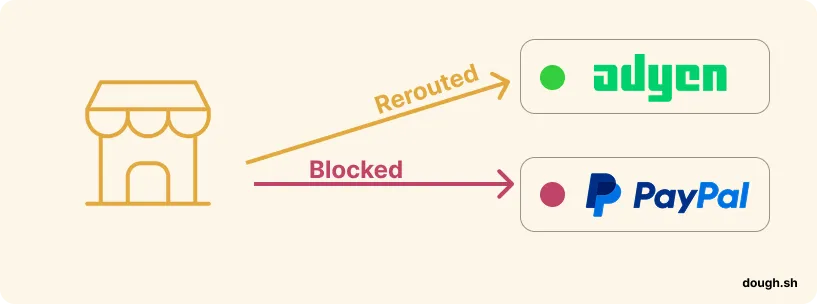
Layer 3: An abstraction layer between your code and every provider. This is the one that requires actual architecture. Instead of integrating Provider A directly, your store talks to a single payment interface, and that interface talks to providers. Switching from Provider A to Provider B stops being a rewrite and becomes routing configuration.
This third layer is the entire reason we built the payments core of Dough the way we did: 100+ payment providers behind one interface. Your checkout, your subscription logic, your webhooks — none of it knows or cares which processor is currently on the other end. When a provider raises prices, degrades, or bans you, you re-route and keep selling, without rewriting code and without losing your customers' saved billing relationships. After my own 2am deplatforming, I promised myself the next ban I received would be a config change. That promise became a product.
You can build this abstraction yourself — open-source payment orchestration exists, and any competent Django or Node developer can wrap providers behind an internal API. What you can't do is bolt it on during the fire. Like the backup merchant account, the abstraction layer only helps if it's there before you need it.
The rest of the deplatform-proof checklist
Payments are the most dramatic dependency, but the same logic applies everywhere a third party can unilaterally end your high-risk business:
- Email: if your transactional ESP throttles you (they do this to high-risk senders too), can you swap SMTP providers without rebuilding templates?
- Hosting: could you redeploy to another host this week, or are you welded to one platform's proprietary services?
- Domain and data: is your customer list exportable, or does it live inside a platform that could suspend you?
The principle is identical each time: every provider is a vendor, every vendor is replaceable, and replaceability has to be designed in — it never happens by accident.
Already banned? Do this first
If you found this article because the termination email arrived this morning: triage first, architecture later. Export every scrap of data you still can, communicate with in-flight customers, and start the high-risk account application today, because underwriting is now your critical path. We wrote a dedicated playbook for the immediate aftermath — what to do in the first 48 hours after a Stripe suspension — covering the appeal process, fund-recovery realities, and how to get a checkout live again fast. Come back to this article once you're processing again, and build the version of your store that never has this problem twice.
Build the store they can't switch off
Being a high-risk merchant in 2026 means accepting two truths at once. The first is sobering: mainstream processors will always treat your category as a liability, thresholds keep tightening, and hoping you'll be the exception is not a strategy. The second is genuinely liberating: dedicated high-risk infrastructure exists, it's mature, and paired with the right architecture it makes your store more resilient than the average Shopify boutique — because you planned for failure and they didn't.
So: open a high-risk merchant account with a provider that actually wants your industry. Keep your chargeback ratio boring. And put an abstraction layer between your business and every company that could end it.
That last part is what we build. Dough is a production-grade foundation for stores and SaaS — payments across 100+ providers behind one interface, 15+ email providers, deploy anywhere — designed by someone who's read the termination email and decided nobody should read it twice. If your revenue currently depends on one provider's mood, come see how the anti-lock architecture works.
How does payment processing work for high risk merchants?
Payment processing for high risk merchants follows the same technical flow as standard merchants—customer payment data is collected, sent to a payment gateway, routed to a payment processor, and submitted to the card networks and issuing banks—but under stricter underwriting and monitoring. High-risk payment processors evaluate industry, chargeback history, average ticket size, and regulatory exposure. Because high-risk accounts often carry greater liability, processors may require rolling reserves, higher fees, shorter payout schedules, and more rigorous KYC documentation.
When am I considered high risk and do I need a high-risk merchant account?
You are considered high risk if your business model, product category, or chargeback and refund patterns increase the likelihood of payment disputes or regulatory issues. Common triggers include adult, gambling, CBD, subscription services, travel, and high-ticket digital goods. If your processor labels you “considered high-risk,” you usually need a high risk merchant account or a high-risk merchant service that specializes in underwriting and monitoring such businesses.
How do I apply for a high-risk merchant account and get merchant account approval?
To apply for a high risk merchant account, gather detailed business documents—proof of identity, business formation, processing history, website content, refund and shipping policies, and chargeback mitigation plans. Submit these to high risk merchant account providers or a high-risk payment processor. Expect enhanced underwriting; merchant account approval can take longer than for standard accounts, and you may be asked to provide bank statements, customer agreements, and possibly a projected processing volume.
What features should I look for in a high-risk payment processor or high-risk merchant service?
Look for a high-risk payment processor that offers a robust high-risk payment gateway, fraud and chargeback prevention tools, clear reserve and payout terms, multi-currency support, and transparent fee structures. Providers experienced with high risk payment and high-risk accounts often provide onboarding support, compliance guidance, and integration assistance to help you create an account that minimizes the chance of deplatforming.
How can I reduce high chargeback risk and keep my high-risk business from being deplatformed?
Reduce high chargeback risk by implementing strong customer communication, clear billing descriptors, easy refund policies, and proactive dispute resolution. Use fraud detection tools, AVS/CVV checks, and transaction monitoring. Document fulfillment and provide tracking for physical goods. High-risk accounts often get flagged for sudden chargeback spikes, so continuous monitoring and fast remediation are essential to prevent termination by your payment processor.
Are there alternative payment methods that help open a high risk merchant or get a high-risk merchant to stay online?
Yes. Alternative payment methods—such as ACH/eChecks, crypto payments, digital wallets, and localized alternative payment methods—can supplement card processing and reduce reliance on a single payment processor. Some high-risk merchants route a portion of sales through a high-risk payment gateway or alternative payment provider to diversify risk and improve resilience against deplatforming by a primary payment processor.
What are risks associated with high-risk industries and how do reserves and rolling reserves work?
Risks associated with high-risk industries include higher fraud rates, regulatory scrutiny, chargebacks, and reputational exposure. To mitigate payout risk, processors may hold a rolling reserve—a percentage of each transaction held for a set period—or a fixed reserve. This protects the processor against future chargebacks. Understand reserve release schedules and negotiate terms where possible to manage your cash flow when running a high-risk business.
How can I get a merchant and create an account if my business was deplatformed previously?
If you were deplatformed, start by addressing the root causes—chargebacks, policy violations, or undisclosed business activities—then compile evidence of corrective actions, updated policies, and reduced chargeback rates. Seek specialized high risk merchant account providers that accept previously deplatformed merchants, and be transparent during underwriting. Consider using a high-risk payment gateway, improving compliance, and possibly staging processing volumes to get your account and build a stable track record.
Sources
Visa Acquirer Monitoring Program Fact Sheet
Visa. _Visa Acquirer Monitoring Program Fact Sheet_ (2025). https://corporate.visa.com/content/dam/VCOM/corporate/visa-perspectives/security-and-trust/documents/visa-acquirer-monitoring-program-fact-sheet-2025.pdf
Visa's new dispute monitoring program requires rethinking fraud and payment strategy
Signifyd. _Visa's new dispute monitoring program requires rethinking fraud and payment strategy_ (2025). https://www.signifyd.com/blog/new-visa-dispute-monitoring/
The MATCH List Explained
Chargeback Gurus. _The MATCH List Explained_ (2026). https://www.chargebackgurus.com/blog/mastercard-match-list-are-you-on-it
High Risk Merchant Account: What It Is & How to Get Approved
Finix. _High Risk Merchant Account: What It Is & How to Get Approved_ (2026). https://finix.com/resources/blogs/credit-card-processing-for-high-risk-merchants
Rolling Reserves for High-Risk Merchants 101
Corepay. _Rolling Reserves for High-Risk Merchants 101_ (2026). https://corepay.net/articles/how-to-survive-merchant-account-rolling-reserves/
High Risk Merchant Account (2025): Best Providers & How They Work
Swipesum. _High Risk Merchant Account (2025): Best Providers & How They Work_. https://www.swipesum.com/insights/high-risk-merchant-account-what-they-are-best-providers-how-they-work
High-Risk Merchant Account Fees: Complete Guide for 2026
TailoredPay. _High-Risk Merchant Account Fees: Complete Guide for 2026_. https://tailoredpay.com/blog/high-risk-merchant-account-fees/
References & Sources
-
Visa Acquirer Monitoring Program Fact Sheet
• — •
https://corporate.visa.com/content/dam/VCOM/corporate/visa-perspectives/security-and-trust/documents/visa-acquirer-monitoring-program-fact-sheet-2025.pdf -
Visa's new dispute monitoring program requires rethinking fraud and payment strategy
• — •
https://www.signifyd.com/blog/new-visa-dispute-monitoring/ -
The MATCH List Explained
• — •
https://www.chargebackgurus.com/blog/mastercard-match-list-are-you-on-it -
High Risk Merchant Account: What It Is & How to Get Approved
• — •
https://finix.com/resources/blogs/credit-card-processing-for-high-risk-merchants -
Rolling Reserves for High-Risk Merchants 101
• — •
https://corepay.net/articles/how-to-survive-merchant-account-rolling-reserves/ -
High Risk Merchant Account (2025): Best Providers & How They Work
• — •
https://www.swipesum.com/insights/high-risk-merchant-account-what-they-are-best-providers-how-they-work -
High-Risk Merchant Account Fees: Complete Guide for 2026
• — •
https://tailoredpay.com/blog/high-risk-merchant-account-fees/